
Elon Musk Could Rewrite the IPO Playbook With SpaceX
Elon Musk is considering an unusually large retail allocation in a future SpaceX IPO, a move that could challenge Wall Street norms and make one of the biggest public debuts in history.
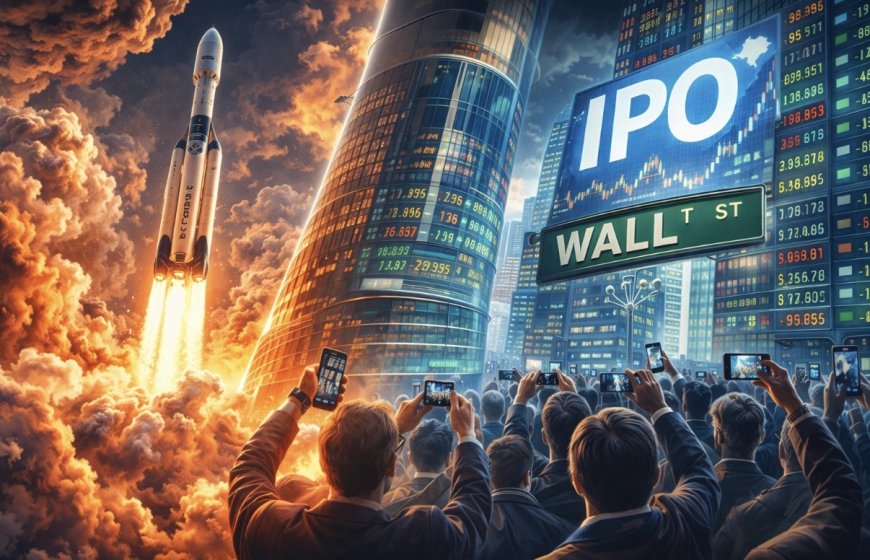
Elon Musk may be preparing to do more than take SpaceX public. He may be trying to reinvent the IPO itself.
The idea under discussion is to allocate as much as 30% of a future SpaceX IPO to retail investors, roughly three times the usual share set aside for individuals. In most IPOs, institutions dominate the allocation and retail investors get a small slice. A SpaceX deal structured this way would flip that model and give everyday investors unusually large access from day one.
That matters because SpaceX is not a normal IPO candidate. At a possible valuation of up to $1.75 trillion, the company would enter public markets on a scale that few businesses in history have even approached.
The size comparison is what makes this potentially historic.
The largest IPO ever completed was Saudi Aramco, which raised about $29.4 billion in 2019. Alibaba raised $25 billion in 2014. Other giants include ICBC at roughly $21.9 billion, Visa at $17.4 billion, Meta at $16 billion, and General Motors at $15.8 billion.
If SpaceX were to raise more than $75 billion, it would not just break the IPO record. It would destroy it. A $75 billion offering would be about 2.5 times the size of Aramco’s record deal, 3 times the size of Alibaba’s, and more than 4 times Visa’s.
Even by U.S. standards, the gap would be enormous. Among the biggest American IPOs by valuation were AT&T Wireless at about $68 billion, Rivian at roughly $66.5 billion, Didi at nearly $61 billion, and UPS at around $60 billion. A SpaceX debut at a valuation of up to $1.75 trillion would be operating in an entirely different universe.
What makes the structure even more unusual is not just the size, but who gets access. IPOs have traditionally been built around large institutions because banks want stable demand and issuers want deep-pocketed shareholders. Musk seems to be betting on something else: that his loyal fan base and long-term backers could help support the stock after it starts trading.
That would be a real break from the traditional Wall Street model. In most blockbuster IPOs, retail demand may drive excitement, but institutions still control the book. A SpaceX IPO with a 30% retail allocation would signal that brand loyalty and investor enthusiasm can be just as powerful as institutional demand.
Nothing is final yet, and the terms could still change. But even as a possibility, the message is already clear: a SpaceX IPO would not be just another giant listing. It could become one of the biggest and most unconventional public offerings ever, resetting expectations for both size and access.
What's Your Reaction?
 Like
0
Like
0
 Dislike
0
Dislike
0
 Love
0
Love
0
 Funny
0
Funny
0
 Wow
0
Wow
0
 Sad
0
Sad
0
 Angry
0
Angry
0

Jane specializes in uncovering hidden market manipulation schemes and investigating hedge funds’ controversial practices. She exposes insider trading and regulatory loopholes in the financial world.








Comments (0)